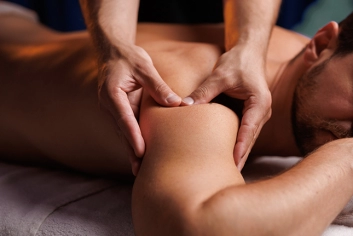










"Sometimes healing doesn't mean becoming someone else. It means letting go of everything that isn't truly you – the expectations, the beliefs, and the tension you've been carrying."~ Rachel Naomi Remen
RESTORE & RELEASE BODYWORK – Because sometimes your body simply needs someone who truly understands it.
Maybe You're Not "Just Tired"
Most women gradually begin to accept everyday discomfort as something normal.
Until one day, they realize they've forgotten what it actually feels like to feel well.
It doesn't happen overnight.
You wake up after a full night's sleep, but your body doesn't feel restored. Your energy fades more quickly than it used to. The tension in your neck, shoulders, or lower back comes and goes, but never completely disappears. Each day ends with the feeling that your body never quite catches up.
Some mornings, your body seems to wake up more slowly than you do. Your first few steps are cautious. Your feet feel stiff. Your back and joints need time before they begin moving freely.
Your neck feels tight before the day has even begun. Your shoulders seem to creep toward your ears without you noticing. You rub them while talking on the phone, working at your computer, or sitting behind the wheel.
By evening, you're exhausted.
You lie down, but your mind keeps going. Your lower back searches for a comfortable position without quite finding one. Your legs feel heavy, and sleep never seems to deliver the deep recovery you were hoping for.
Some days, nothing feels seriously wrong. And yet, you don't feel truly well. You move, but not as freely as you once did. You rest, but never fully recover. The same areas tighten again and again, no matter how often you promise yourself you'll sit with better posture, get up more often, stretch more, or go to bed earlier.
Little by little, it all begins to feel normal.
"I work too much."
"It's just part of getting older."
"Tomorrow will be better."
"Everyone feels tired."
"Stress is simply part of life."
Work is demanding. The days are long. And there's always someone or something that needs you.
So you make another coffee. Roll your shoulders. Stretch your neck. Tell yourself you'll finally rest this weekend.
Then the weekend comes. And goes. Without ever bringing you fully back to yourself.
Eventually, you begin believing that you simply sleep lightly. That your lower back has always been weak. That the tightness in your shoulders is just part of daily life. That your age, your work, or your lifestyle naturally come with a certain amount of discomfort.
But how much of that is truly part of you? And how much of it is your body trying to get your attention? How much have you accepted as normal simply because you've lived with it for so long?
Restore & Release Bodywork is a restorative therapy for women built on one simple principle: before choosing the right technique, we first need to understand the body in front of us.
Every session begins with attention. With observation. With conversation.
And with one simple question: What does your body need today?
Because every body tells a different story. The way it moves, where it stores tension, and how it responds to physical and emotional demands is unique to each individual. Before the treatment begins, we take the time to understand that story. Only then can we choose the approach that best supports your body.
But why does tension sometimes remain long after the stressful period has passed?
Why doesn't the body simply relax once the cause is gone?
The answer lies in one of the human body's most remarkable abilities:
its ability to adapt.
Why Does the Body Remember?
The human body is constantly changing. It was never designed to remain the same throughout life. Every cell, every muscle, and every part of the nervous system continuously adapts to the environment we live in. This remarkable ability allows us to recover after injury, learn new movements, and meet the physical demands of everyday life.
In biology, this process is known as "adaptation".
Without it, we simply couldn't survive. Yet adaptation doesn't distinguish between what benefits us and what doesn't. Your body doesn't keep a calendar of your life - it remembers repetition.
It doesn't matter whether you've had one stressful day or spent three years under constant pressure. What matters is what happens often enough to become your body's normal.
Your body doesn't know whether you've spent eight hours sitting at a desk, whether you clench your jaw when you're stressed, or whether your shoulders rise toward your ears every time life becomes demanding. It notices only one thing: "What happens most often?" Then it begins to adapt.
If the same muscles work harder than they should every day, the nervous system gradually activates them more easily and more quickly. Muscles that are rarely used become less active. Over time, the body develops a new movement strategy - one that may be efficient in the moment, but not necessarily beneficial in the long term.
Every movement begins as a conscious action. But when we repeat it enough times, the brain no longer needs to build it from scratch. Instead, it relies on an existing pattern because doing so requires less energy.
That's how we learn to ride a bicycle. It's how we type without looking at the keyboard. Eventually, we stop thinking about the movement altogether - it becomes automatic.
The same process can also create habits that no longer work in our favor.
If, day after day, you work with rounded shoulders, hold your phone between your shoulder and ear, or constantly tighten the muscles around your neck and jaw, your nervous system gradually begins to treat those patterns as normal simply because they're the ones it uses most often.
Imagine a path through a forest. The first person has to push through the grass. Then another follows. And another. With every step, the ground becomes more worn until a clear trail naturally appears.
Your nervous system works much the same way. The more often it uses a particular movement pattern, the easier it becomes to activate the next time. Familiar pathways require less effort, so the body naturally prefers them. That's why old habits don't disappear simply because you've decided to stand up straighter or relax your shoulders.
A new pattern has to be repeated consistently before it gradually becomes more familiar than the old one. This rarely happens overnight. It unfolds over weeks, months, and sometimes years.
That's why people often say, "I'm not sure when it started. It feels like it's always been this way."
But it hasn't.
There was a time when your body moved differently. After enough repetition, however, the new pattern simply became your body's normal.
The same process also takes place within the fascia - the network of connective tissue that surrounds and connects muscles, tendons, joints, nerves, and organs. When movement is varied, fascia remains supple, allowing the body's structures to glide smoothly against one another. But when the same positions and movements are repeated day after day, its mechanical properties can gradually change. As a result, certain areas may begin to feel tighter, less mobile, and increasingly difficult to relax.
Even the way we breathe can change. During prolonged periods of stress, many people unconsciously rely more on the muscles of the neck and upper chest than on the diaphragm. Once this becomes habitual, every breath places additional strain on muscles that were never meant to work continuously.
Over time, these changes begin to build on one another. Limited movement in one area alters movement elsewhere. Some muscles start compensating for others. Certain tissues become overloaded, while others gradually lose their normal level of activity.
The body always finds a solution. Sometimes, however, that solution is a compromise.
In the short term, it can be incredibly useful. It allows us to keep working, exercising, caring for our families, and simply getting through difficult periods of life.
The challenge is that the body rarely receives the message that those difficult periods have ended.
Unless we gradually begin using our full movement potential again, the body has no reason to abandon the strategy that once helped protect us.
None of these adaptations is a problem on its own. Each one represents the body's remarkable ability to adjust.
Ironically, the same ability that allows us to heal, grow stronger, and learn new skills can also cause us to preserve movement patterns that no longer serve us.
It's also important to understand that pain and tension are not the same thing.
You can experience significant muscular tension without pain, just as pain can exist even when muscles don't appear especially tight. That's because pain is produced by the nervous system and influenced by many different factors, including tissue health, how the brain interprets sensory information, previous experiences, physical load, sleep quality, stress, and countless other biological processes.
Modern medicine increasingly views the body as one interconnected system. Muscles, fascia, joints, the nervous system, and breathing don't function independently - they constantly influence one another. That's why an individualized approach is so important.
Two people may have exactly the same complaint for completely different reasons. A stiff shoulder, a tight neck, or lower back pain may all be part of very different patterns of adaptation.
That's why recovery rarely begins with the question "Where does it hurt?"
A more meaningful question is often: "How did your body get here?"
Problems arise when temporary adaptations gradually become permanent ones. That's why tension doesn't always disappear once the original cause is gone.
Perhaps you've already changed jobs. The vacation has ended. An old injury has healed. Yet your body continues using the same protective strategies because, for a long time, they helped you cope.
Your body doesn't remember the past the way you do. It simply continues relying on the strategies that once kept you safe. Sometimes, the body is still protecting itself from a day that ended long ago.
The Good News - Adaptation works both ways.
The same remarkable ability that allows the body to develop movement habits also allows it to build healthier ones. Just as a well-worn forest path doesn't disappear overnight, long-established movement patterns don't change instantly. But when healthier pathways are repeated consistently, the body gradually recognizes them as the better option and eventually adopts them as its new normal.
That's why recovery is rarely about a single treatment. It's a process - a gradual process in which the body learns to move differently, recruit muscles more efficiently, distribute load more evenly, and let go of protective strategies it no longer needs.
A well-designed therapy doesn't erase old patterns. It creates the conditions for your body to build better ones.
And that's one of the most remarkable qualities of the human body. It never stops adapting.
The only question is: What is your body adapting to today?
Why One Area of Tension Is Rarely Just One Area
Why Pain Doesn't Always Begin Where You Feel It?
When something hurts, it's only natural to expect treatment to begin exactly where you feel the pain. But the human body is rarely that simple.
Sometimes, tension in the neck is connected to the way the shoulders move. In other cases, the lower back becomes overloaded because the pelvis no longer moves freely. Even restricted movement in the foot can gradually change how forces are distributed through the knee, pelvis, and eventually the spine.
Over time, these changes begin to build on one another. Limited movement in one area changes the way another area moves. Some muscles begin compensating for others. Certain structures take on more work than they were designed to handle, while others gradually become less active.
This is known as compensation - one of the body's most remarkable survival mechanisms.
When one structure can no longer perform its role efficiently, the body rarely stops moving. Instead, it finds another way. One muscle begins working harder. Another joint absorbs more of the load. A different movement gradually replaces the one that's no longer happening freely.
The body always finds a solution. Sometimes, however, that solution is a compromise.
Imagine driving a car with poorly aligned wheels. The car continues to run, and for quite some time you may not notice anything unusual. But the load is no longer distributed evenly. One tire begins wearing out faster than the others. Then the suspension comes under greater strain. Eventually, other problems begin to appear. The car still works, but it is no longer operating as efficiently as it could. Over time, the cost of that compensation continues to grow.
The body works in much the same way. When one structure contributes less, another quietly takes on more. At first, this is a brilliant adaptation. But if it continues for too long, the structures doing the extra work eventually begin paying the price.
Imagine someone who sprains an ankle. During the first few days, they naturally shift their weight to avoid pain. That's exactly what the body should do. But if weeks or even months later they continue walking the same way, the knee, pelvis, and lower back gradually begin carrying more of the load.
At that point, the ankle is no longer the real issue. The problem is the movement strategy the body has learned in order to protect it.
The same kind of compensation happens in everyday life. When one shoulder remains elevated, the opposite side gradually takes on more work. When the pelvis becomes less mobile, the lower back often compensates by moving more. When the rib cage loses mobility, the neck begins working harder, even during normal breathing. And when someone unconsciously clenches their jaw for months, tension can gradually spread into the neck, shoulders, or temples.
In the short term, these compensations can be incredibly helpful. They allow us to keep working, exercising, caring for our families, and simply getting through difficult periods of life. Every compensation is a solution, but every solution comes with a cost. While one part of the body is protected, another quietly begins working harder. At first, we barely notice. Over time, however, what began as temporary support can gradually become a permanent source of overload.
The challenge is that the body rarely receives the message that the difficult period has ended. Unless we gradually begin using our full movement potential again, the body has no reason to abandon the strategy that once helped protect us.
None of these changes means that something is inherently wrong with the body. They are simply the body's natural attempt to adapt. In fact, this remarkable ability is what allows us to recover, become stronger, and meet the physical demands of everyday life.
Sometimes, however, the very same mechanism preserves movement patterns that are no longer useful. That's why treating only the place where you feel pain isn't always enough.
Sometimes the painful area truly is the source of the problem. Other times, it is simply the part of the body that has been carrying the greatest burden for the longest time.
This doesn't mean the cause is always somewhere else. It means the body deserves to be understood as one integrated system rather than a collection of separate parts.
That's why, before treatment begins, your therapist observes how different areas of the body work together. The goal isn't simply to identify where tension exists, but to understand how that tension influences movement throughout the body.
Sometimes, the greatest improvement comes not from spending more time on the painful area, but from releasing the region that's forcing it to compensate.
The goal isn't simply to follow the pain.
The goal is to understand why the body began moving this way in the first place.
What Is Restore & Release Bodywork?
Restore & Release Bodywork is a deeply restorative therapy created specifically for women. Every session is tailored to your individual needs rather than following a predetermined protocol.
Treatment begins with a brief conversation about how you're feeling, where you're experiencing tension, and what you hope to achieve. Based on that assessment, your therapist selects the techniques that best support your body on that particular day.
Techniques:
Depending on your body's needs, your session may incorporate a combination of:
- Deep tissue techniques
- Myofascial release
- Trigger point therapy
- Manual lymphatic drainage
- Assisted stretching
- Muscle relaxation techniques
- Myofascial chain therapy
- Fascial restriction release
- Neuromuscular techniques
- Reflexology
Not every technique is used in every session. Each treatment is thoughtfully customized to provide the approach your body needs most.
During Your Treatment
The level of pressure is always adjusted to your comfort. Some areas may feel more sensitive, particularly if they've been under strain for a long time, but the goal is never to cause unnecessary pain. Effective bodywork isn't defined by how much pressure is applied.
Sometimes, greater results come from greater precision.
After Your Treatment
Every body responds differently. Many women notice a greater sense of lightness, easier movement, deeper breathing, and profound relaxation, even after their first session.
Following deeper therapeutic work, it's normal to experience mild tenderness in certain areas for a day or two. This is a common response and usually resolves quickly.
To support the best possible outcome, we recommend drinking plenty of water after your session, avoiding intense physical activity for the rest of the day, and giving your body the time it needs to recover.
The Female Body Doesn't Follow a Straight Path
A woman's body isn't the same at 20, 35, 50, or 65. It doesn't move through life in a straight line. Instead, it's constantly changing with age, through different stages of life, and even throughout the course of a single month.
Many approaches to recovery are designed as though the body functions the same way every day. In reality, the female body is continually adapting. Hormone levels fluctuate, sleep patterns change, energy rises and falls, pain sensitivity shifts, recovery speeds vary, and the way the body responds to physical and emotional stress evolves over time.
That's why a woman may feel energetic and resilient during one part of the month, yet find the very same activities far more demanding just a couple of weeks later. This isn't unusual. It's simply part of how the female body is designed to function.
Every Stage Leaves Its Mark
Throughout life, a woman's body moves through a series of natural transitions:
- Menstrual cycles
- Pregnancy
- Childbirth
- Breastfeeding
- Years of carrying and caring for children
- A demanding professional career
- Perimenopause
- Menopause
- The natural changes that come with aging
Each of these stages places different demands on the body. It is constantly adapting to new circumstances, often so gradually that the changes go unnoticed until one day tension, fatigue, or stiffness become much more noticeable. Sometimes the adaptation is short-lived. Sometimes it continues for years. Through every stage, however, the body never stops adjusting.
It's About More Than Hormones
When people talk about women's health, the conversation often focuses almost entirely on hormones. In reality, the changes are much broader.
As we age, muscle mass gradually changes, connective tissues become less elastic, joint mobility shifts, sleep quality evolves, and the body's ability to recover after physical activity often slows. These changes are a natural part of life, but they also influence how the body feels and functions every day.
The body doesn't remember your age. It remembers your accumulated load.
Years spent working at a computer. Thousands of hours behind the wheel. Carrying a child on one hip. Interrupted sleep. Long-term stress. Too little movement. Too little time for yourself.
Most of the time, there isn't one single cause. More often, the body reflects the accumulated effects of dozens of small physical and emotional demands that have gradually built up over many years.
Research suggests that changes in estrogen levels may influence muscles, tendons, connective tissue, and the body's ability to recover after physical activity. At the same time, chronic stress and poor sleep can increase pain sensitivity, contribute to stiffness, and slow the body's natural recovery processes.
These changes don't affect every woman in the same way. That's why there is no universal approach that's equally appropriate for everyone. What science clearly shows is that the needs of the female body continue to change throughout every stage of life.
Every Woman Has Her Own Story
For some women, tension begins after years of working at a computer. For others, it develops after pregnancy, after carrying a young child, after months of interrupted sleep, after years of intense training, during a prolonged period of stress, or as they enter perimenopause.
Sometimes there isn't a single defining event at all. The body has simply spent years giving more than it has had the opportunity to restore.
That's why two women can arrive with exactly the same complaint while needing completely different treatment. That's precisely why we created Restore & Release Bodywork.
Restore & Release Bodywork doesn't treat hormonal disorders, nor can it stop the natural biological changes that occur with age. What it can do is support your body as it moves through those changes while adapting each session to how you feel today.
Instead of following the same sequence for every woman, each treatment is guided by your body's current condition, the tension it has accumulated, and the way it is responding during this stage of your life. At one time, the focus may be on releasing deep muscular tension. At another, a gentler and more restorative approach may be exactly what your body needs.
Because a body that is constantly changing deserves a therapy that knows how to change with it.
The Connection Between Emotions and the Body
A woman experiences life with her whole being, not just with her mind, but with her body as well. Every day brings countless emotions, both large and small. The satisfaction of a job well done. The excitement before an important event. The joy of seeing someone you love. Caring for your family. Responsibility. Anticipation. Uncertainty. Disappointment. Love. Inspiration. Peace.
These moments constantly overlap, intertwine, and shape our lives. Some fill us with energy. Others quietly drain it. Yet almost every emotion leaves its imprint on the body.
The Body Is Part of Every Emotion
Think about how your body responds when you receive wonderful news. A smile appears without effort. Your eyes brighten. Your breathing becomes fuller. Your face softens. Your whole body seems to feel lighter.
The opposite happens just as naturally. During a difficult conversation, you may unconsciously clench your jaw, lift your shoulders, hold your breath, tighten your fists, or notice your heart beating faster.
The body often reacts before the mind has fully processed what's happening. And it does this every single day, often without us even realizing it.
Women Often Carry More Than Anyone Sees
Along with their own emotions, many women quietly carry the emotional weight of the people around them. They sense the atmosphere at home, the tension at work, a child's worries, a partner's exhaustion, or the concerns of aging parents, sometimes before a single word has been spoken.
This sensitivity is a remarkable strength. It allows women to be compassionate, intuitive, and deeply caring. But it also has another side.
The more attention we give to everyone else, the easier it becomes to lose touch with what our own body is trying to tell us.
Tension Doesn't Build Overnight
Most women become incredibly skilled at moving forward.
They finish one more task. They solve one more problem. They organize. They help. They listen. They reassure everyone by saying, "It's okay."
And for a while, it works. For a day. For a week. Sometimes for years.
Many women become the person who always finds a solution. But even the strongest person needs a chance to put the weight down from time to time. Not because she isn't capable of carrying it, but because she was never meant to carry it all the time.
Meanwhile, the body continues responding to every emotion, every responsibility, and every source of stress. At first, the changes are almost impossible to notice. Then the shoulders begin to stay slightly raised. The jaw feels tighter more often. The neck becomes tired more easily. Breathing no longer feels as effortless as it once did.
Alongside physical demands, prolonged emotional stress may also contribute to the gradual accumulation of tension within the muscles and fascia.
When Was the Last Time You Felt Truly at Peace?
Not for five minutes.
Not while watching a show.
Not while sleeping.
But that deeper kind of calm, when your body isn't already preparing for the next task. When your mind isn't thinking about tomorrow. When you're not on alert, rushing, or planning your next move.
You're simply present.
Many women struggle to remember the last time they experienced that feeling. Not because their lives are necessarily difficult.
But because they're full.
Full of people.
Full of responsibilities.
Full of careers.
Full of decisions.
Full of caring for others.
And full of countless small demands that seem insignificant on their own, yet slowly begin filling every available space when added together.
Even the space within ourselves.
Receiving the Care You So Freely Give to Others
Most women are accustomed to giving. They give their time, their attention, their energy, and their support. They become the person everyone depends on. Far less often do they allow themselves to simply receive. To receive without planning. Without organizing. Without thinking about what comes next.
Restore & Release Bodywork was created for exactly these moments.
Moments when you don't have to rush. When you don't have to be the strong one. When you don't have to think about your phone, your to-do list, or everything waiting for you after you leave.
All you have to do is be here.
Breathe.
Allow your body to gradually return to its natural rhythm.
Because sometimes the greatest gift a woman can give herself isn't another achievement.
It's time.
Attention.
Care.
And the comforting feeling that, for a little while, someone is caring for her with the same devotion she gives to everyone else.
Who Is Restore & Release Bodywork For?
Restore & Release Bodywork was created for women who give so much of themselves every day, often placing their own well-being at the bottom of the list.
It's for women who care for their families, build careers, support the people they love, and manage the countless responsibilities of everyday life, yet rarely find enough time to care for themselves.
This therapy may be an excellent choice if you feel your body needs more attention, recovery, and care, whether that's because of:
* Chronic fatigue
* Persistent muscle tension
* Morning stiffness
* A feeling of heaviness or overall body stiffness
* Difficulty relaxing
* Restless or poor-quality sleep
* Mental or emotional exhaustion
* Long-term stress
* Too little time for recovery
* A sedentary lifestyle or prolonged sitting
* Long hours working at a computer
* Frequent driving or long commutes
* Repetitive movements at work or in daily life
* Reduced mobility
* Built-up tension in the neck, shoulders, back, lower back, or pelvis
* Intense physical activity
* The postpartum period (with your physician's approval)
* The physical demands of motherhood and caring for young children
* Caring for an aging family member
* Perimenopause
* Menopause
* A busy, demanding lifestyle
Whether your body is carrying the effects of physical strain, long-term stress, a particular stage of life, or simply years of putting everyone else's needs before your own, every session is individually tailored to you. Rather than following a fixed protocol, each treatment is adapted to your body's current condition, the tension it has accumulated, and the way it is responding on that particular day.
It All Begins with You
A woman's body never stops changing. That's why we believe truly effective therapy shouldn't follow a predetermined protocol.
It begins with listening. It continues with understanding. And it adapts to the woman you are today.
Sometimes recovery doesn't begin with pushing harder.
Sometimes it begins by giving yourself permission to pause. To make time for yourself. To receive the care you've been giving so freely to everyone else.
To remember what it feels like to move with ease, to breathe more deeply, and to feel comfortable in your own body again.
Because sometimes the most important care isn't the care you give to everyone else.
It's the care you finally allow yourself to receive.
|
Restore & Release Bodywork - Deep restorative therapy for women | A restorative deep tissue therapy created with the unique needs of the female body in mind. Combining deep work on the muscles and connective tissue with a gentler, recovery-focused approach, it helps release accumulated tension, physical fatigue, and movement restrictions. It is ideal for women experiencing heaviness, stiffness, tiredness, or discomfort caused by stress, prolonged sitting, physical strain, or the demands of a busy lifestyle. Reflexology enhances the therapy through focused work on the feet - the foundation that supports the entire body every day. In addition to bringing a pleasant sense of relief to tired feet and legs, it supports recovery after prolonged standing, walking, physical exertion, and fatigue. Combined with deep tissue bodywork, it promotes a greater sense of balance, lightness, and stability throughout the body, making the restorative experience even more complete and rewarding. |
|